
Grill Me workflow guide · 6 min read
Kanban for Grill Me: scale planning across agents
Keep each Grill Me plan on a researched card that agents can refine, execute, and review in parallel.
Tao Wu · Builder of AI4KanbanOn this page
- What are grill-me and grill-with-docs?
- Why put Grill Me on a Kanban?
- Does every card investigate before asking questions?
- Can agents answer product decisions autonomously?
- Is this still Kanban if the visual board is optional?
- How do multiple agents work without repeating each other?
- What does the human actually read?
Matt Pocock's grill me workflow stress-tests a plan through focused questions until its decision tree is resolved. It researches answers available in the codebase, gives a recommendation with each genuine decision, and turns a vague idea into shared understanding.
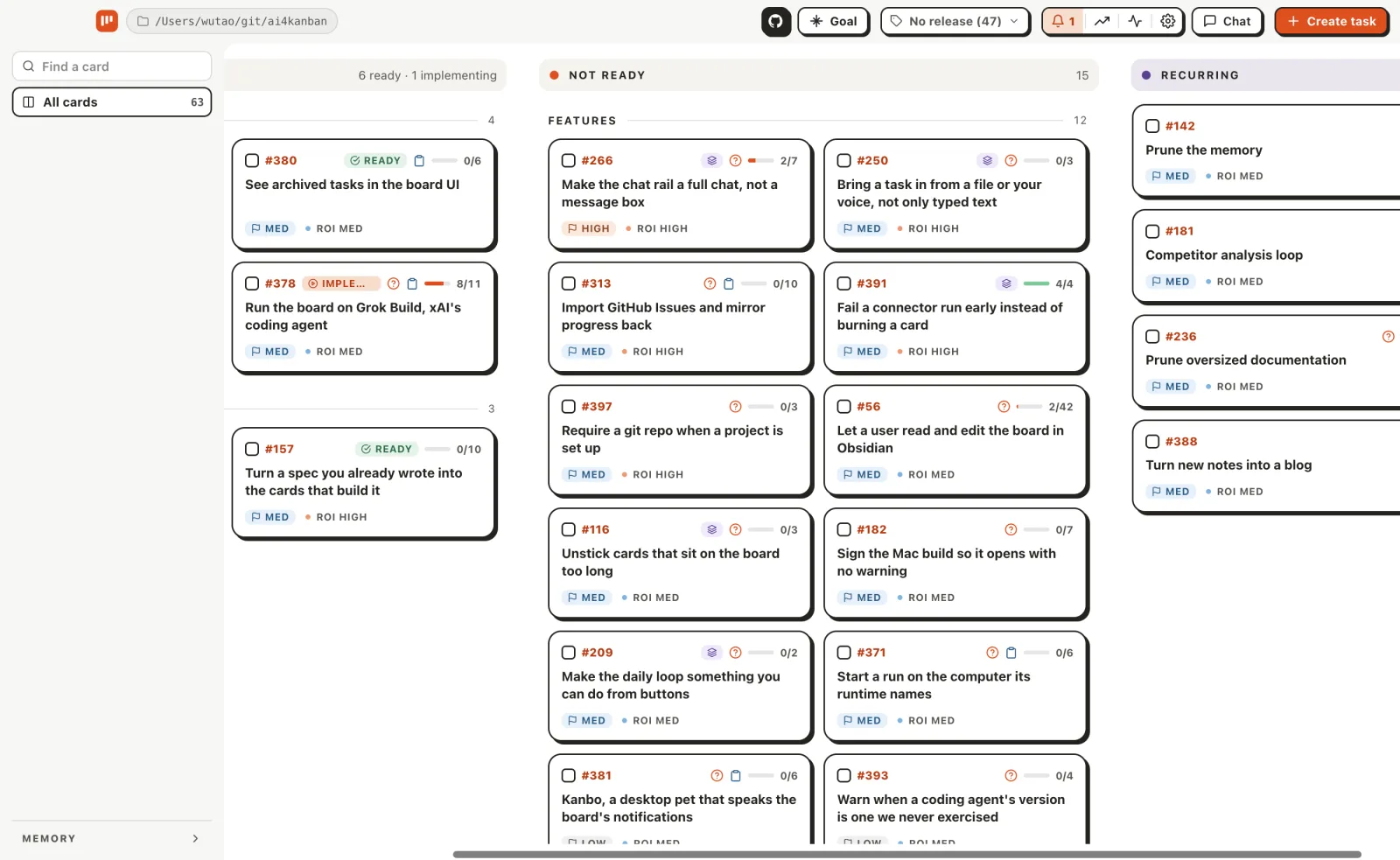
That works well for 1 plan. In AI4Kanban, each card can map to 1 such plan. A project grows from those cards: some stand alone, some share decisions, and some depend on others. AI4Kanban adds that coordination without changing what Grill Me clarifies.
What are grill-me and grill-with-docs?
grill-me is a planning interview. The agent walks through the decisions behind an idea, one branch at a time, and investigates the repository instead of asking you factual questions it can answer itself.
grill-with-docs combines that interview with durable domain documentation and architecture decision records.
AI4Kanban starts from the same principle and keeps the same unit of work.
| Layer | What it adds |
|---|---|
grill-me | Investigates and resolves 1 plan |
grill-with-docs | Keeps domain documentation and decision records current while resolving that plan |
| An AI4Kanban card | Keeps 1 plan as a durable card, then adds dependencies, priority, modules, release, todos, notable answers, and delivery state |
For software projects, AI4Kanban replaces the standalone Grill Me session with a durable card while keeping the same unit of work: 1 plan. Those independently reviewable cards then form the larger project.
Why put Grill Me on a Kanban?
Running 10 planning interviews at once is easy. Keeping their assumptions consistent is the hard part.
Without a shared project model, parallel agents can ask the same question, choose conflicting defaults, work on overlapping files, or implement a dependent feature too early. A longer prompt does not solve the coordination problem.
AI4Kanban starts from individual cards. Each card can hold 1 Grill Me plan and is bounded enough for its own requirement review, implementation, and delivery review. As cards accumulate, the project emerges from their relationships. The board adds fields agents can act on:
| Card field | What it controls |
|---|---|
| Dependencies | Which cards must wait and which can run together |
| Priority | What should be prepared or delivered next |
| Modules | Which project memory and product area apply |
| Release | Which outcome the card contributes to |
| Todo | What must be true before the card is complete |
One specification
A coordinated task graph
Does every card investigate before asking questions?
Yes. Like grill-with-docs, AI4Kanban expects the agent to investigate before it asks.
The agent reads the card, repository, project goal, related work, and relevant project memory. It settles factual questions from evidence, fills in routine implementation detail, and tests the requirement for missing outcomes, boundaries, edge cases, dependencies, and verification criteria.
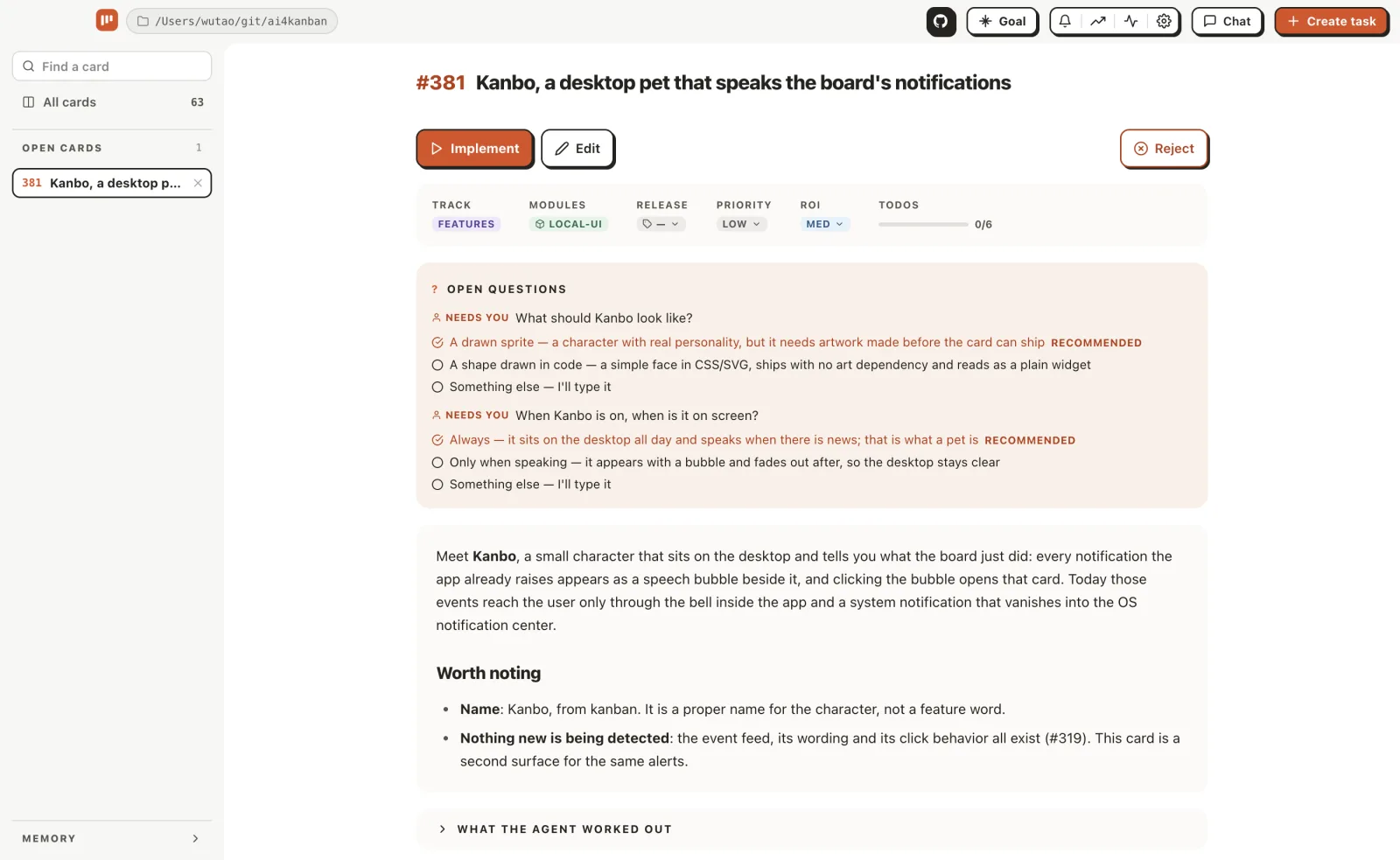
Only a decision that cannot be settled from project evidence should become a question. The card then carries concrete options, the outcome and cost of each option, and the agent's recommendation.
Can agents answer product decisions autonomously?
Yes. AI4Kanban does not require a person to answer every question merely because it concerns the product.
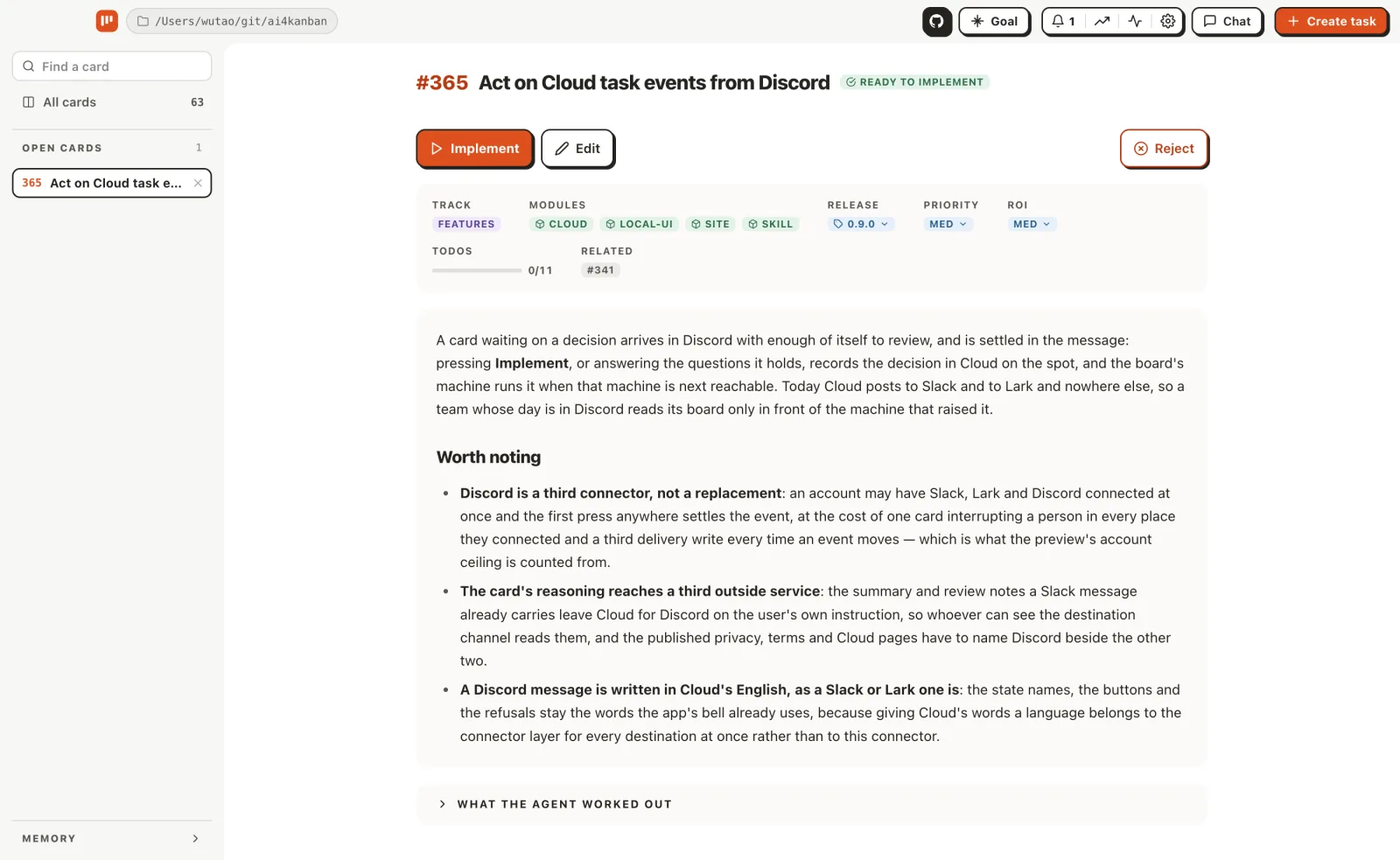
When project evidence supports a safe choice, the agent answers it and continues. If that answer materially changes behavior, scope, risk, privacy, compatibility, or ongoing cost, the card records it under Worth noting for review. The decision is visible without blocking the task.
| Finding | What AI4Kanban does |
|---|---|
| Fact available in the project | Researches and answers it |
| Routine or reversible decision | Chooses a safe default and continues |
| Consequential decision with enough evidence | Answers it, records it under Worth noting, and continues |
| Consequential decision without enough evidence | Leaves a user-owned question with options and a recommendation |
| Result that only a person or external environment can judge | Adds a reproducible human verification step |
This keeps autonomy high without hiding meaningful product calls. The human reviews the decisions worth noticing instead of serving as the answer engine for every card.
Is this still Kanban if the visual board is optional?
Yes. Here, Kanban is a project-management method for turning a vague idea into actionable work. The visual board is one interface, not the source of the method.
Traditional boards are designed mainly to help people scan status. AI4Kanban's board is also read and updated by agents. Its Markdown cards make outcomes, dependencies, questions, decisions, modules, releases, and todos explicit enough for either side to continue the work.
The result is a shared workspace where:
- Agents can discover ready work without waiting for a fresh prompt.
- Humans can inspect a bounded requirement instead of an agent's entire conversation.
- Another agent can review the same card independently.
- Project state survives context compaction, stopped sessions, and model changes.
How do multiple agents work without repeating each other?
The board gives every run a clear ownership boundary. One card defines the outcome and the parts of the project it may change. Dependencies stop work that is not ready, while independent cards can run in isolated Git worktrees.
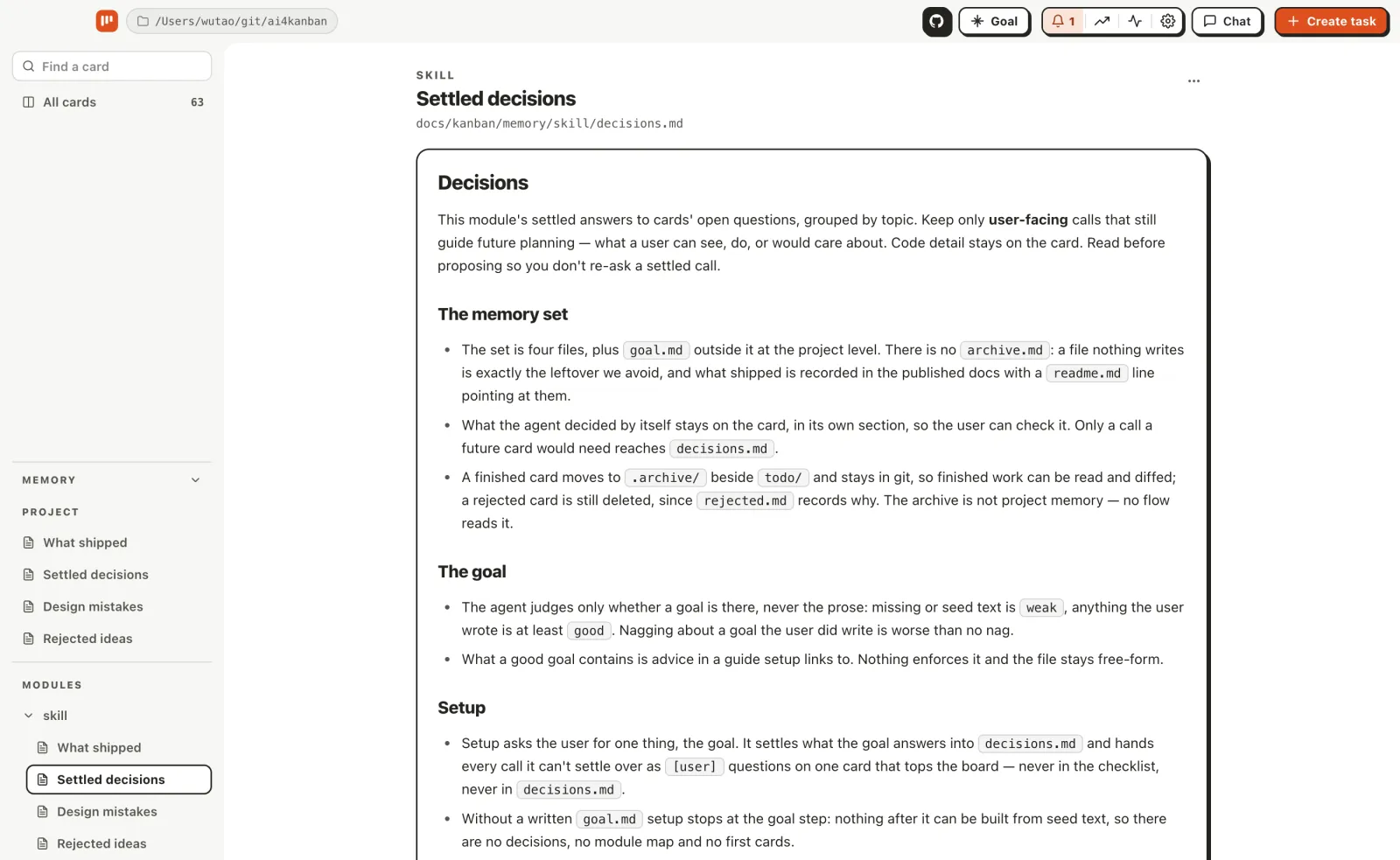
Project and module memory carry forward shipped behavior, current decisions, rejected directions, and design lessons. Later cards receive the memory relevant to their modules instead of replaying every earlier conversation.
This addresses a recurring problem in documented grilling workflows: users have reported important interview decisions missing from an ADR and rationale being lost when a grilling session becomes a specification. AI4Kanban keeps the approved requirement and notable answers on the card, then promotes reusable decisions into project memory.
What does the human actually read?
Not a full specification and not a PRD. Each card is split into a short human half and a folded agent half.
| Card half | What it contains |
|---|---|
| Human half | The task summary, genuine open questions, Worth noting decisions made during planning, and Worth noting after implementation decisions surfaced while building |
| Agent half | Current behavior, detailed scope, todos, routine agent decisions, specialist work, and sources needed to implement and review the task |
The human half is a curated task brief, usually around 30 lines per card. The agent half can carry the miscellaneous detail that another agent needs without making the person read it.
After delivery, Check by hand items give the user reproducible manual verification: the setup, action, expected result, and any fixture required. The human can inspect the completed behavior step by step instead of interpreting an implementation log.
The human sets direction, answers genuine exceptions, and reviews delivery. Questions and approvals appear in the app and can be sent to Slack. A card waiting for judgment does not stop unrelated cards from moving.
Frequently asked questions
How is AI4Kanban different from running grill-with-docs once?
grill-with-docs clarifies and documents 1 plan. One AI4Kanban card can hold that plan, while the board adds its relationships to other cards, reusable decisions, execution state, and delivery order.
Does AI4Kanban replace Grill Me?
Yes, for software projects. AI4Kanban instruments Grill Me's single-session planning process as a durable card, then adds a GUI, autonomous research and decisions, dependencies, shared memory, specialist and review runs, notifications, and multi-agent delivery.
Standalone Grill Me remains more general because it is a short prompt that can run anywhere. Use it for non-software work or when you only want a one-shot plan pressure-tested without creating a project workspace.
Does AI4Kanban replace traditional spec-driven development?
Often yes; in a process that still requires formal specification documents, partly. Traditional spec-driven development produces long task specifications that take time for people to read even though an agent eventually consumes most of the detail.
AI4Kanban keeps that detail in the folded agent half of each card. The person reads the curated human half and its Check by hand steps, while agents read the full implementation brief. A PRD may still define higher-level product direction; it is not the task-level artifact this card structure replaces.
What happens if I reject an agent-made product decision?
Revise the card before implementation or return the delivery for changes. The corrected decision remains with the task and can be added to project memory so later agents do not repeat it.
Can other cards continue while one needs my answer?
Yes. Only the work that depends on that unanswered decision waits. Independent ready cards can continue through preparation, implementation, and review.