
Claude Code workflow guide · 8 min read
Kanban for Claude Code: shared project memory across tasks
A repository board that prepares Claude Code tasks and preserves the decisions every session needs.
Tao Wu · Builder of AI4KanbanOn this page
- Claude Code has task lists. AI4Kanban keeps the project backlog.
- How does AI4Kanban prepare Claude Code before coding?
- What project context survives between Claude Code sessions?
- How do Claude Code subagents and agent teams fit?
- Does AI4Kanban replace my Claude Code configuration?
- Can a failed card resume the same Claude Code session?
- Can AI4Kanban supervise several Claude Code tasks at once?
- Which decisions and approvals pause AI4Kanban?
Claude Code can coordinate several coding sessions with subagents, agent view, agent teams, native task lists, and Git worktrees. Those features manage work while Claude is running.
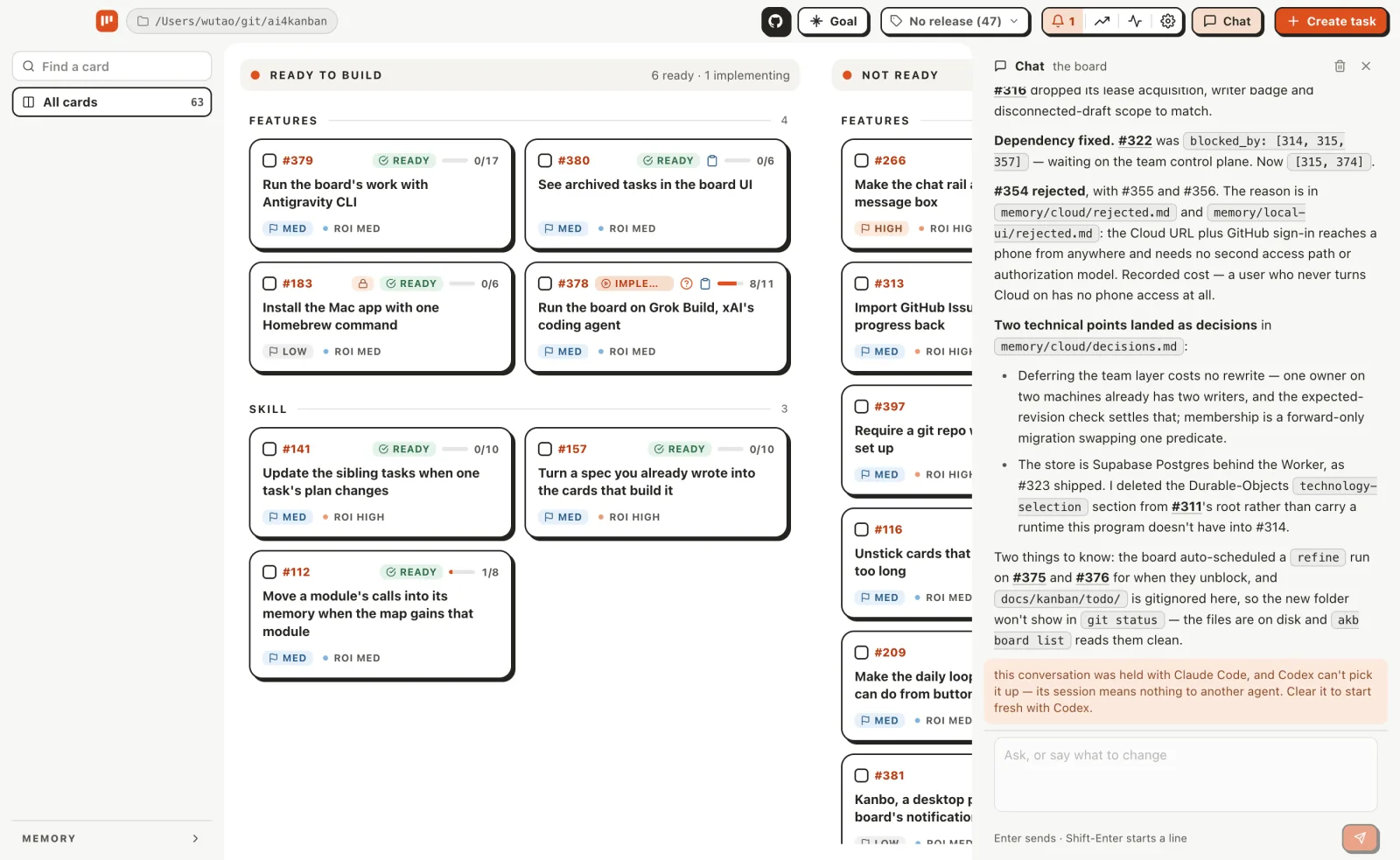
AI4Kanban keeps the project outside those sessions: which requests are ready, which tasks are blocked, which product decisions every task must follow, and what happened after a Claude Code run ended.
Claude Code has task lists. AI4Kanban keeps the project backlog.
Claude Code offers several ways to run agents in parallel. Its task lists coordinate work claimed by an active agent team. AI4Kanban stores the project board itself: rough ideas, prepared requirements, open decisions, dependencies, recurring work, delivery state, and completed outcomes.
| Claude Code feature | What it manages | What AI4Kanban records in the repository |
|---|---|---|
| Session plan or task list | Work inside the current session or agent team | Approved requirements, open questions, dependencies, and verification criteria |
| Subagents | Bounded work returned to the parent session | The task that owns the outcome and its delivery history |
| Agent teams | Workers, messages, and dependencies inside that team | Project work before the team starts and after the team stops |
| Agent view | Claude Code sessions that are running now | Ready, blocked, recurring, running, review, and completed work |
| Worktrees | Separate files for concurrent sessions | Task ownership, review state, landing order, and conflict handling |
An AI4Kanban card is 1 repository-backed task. It remains on the board when a Claude session ends, an agent team shuts down, or you open the project on another machine.
How does AI4Kanban prepare Claude Code before coding?
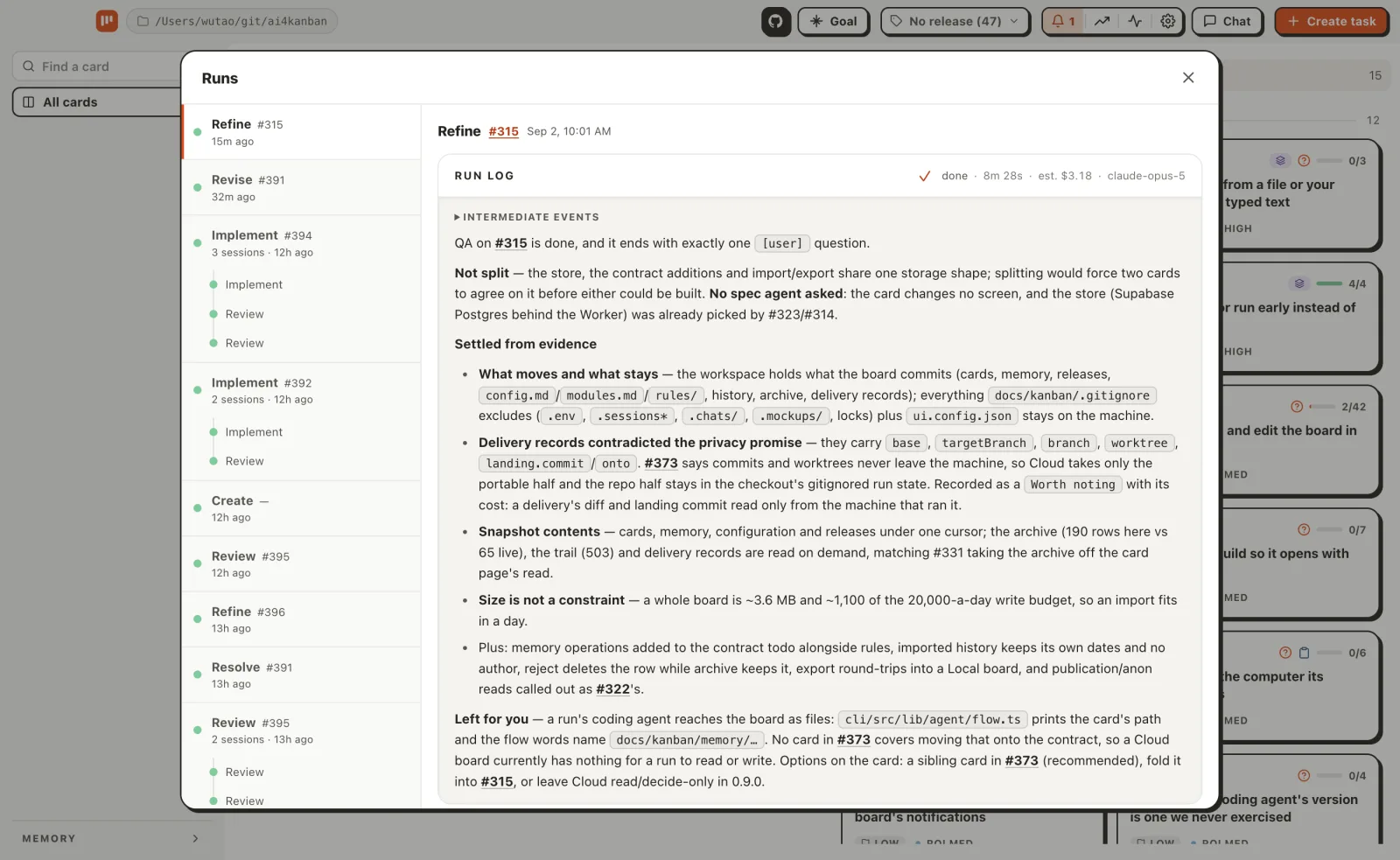
AI4Kanban uses Claude Code to refine a rough request into a build-ready task. Refinement happens before implementation: Claude reads the repository, project goal, related tasks, and previous product decisions, then writes the missing detail onto the card.
Claude Code is expected to settle factual questions itself. It inspects the code, checks existing behavior, and chooses a safe answer when the repository provides one. AI4Kanban stops only when the remaining choice changes product behavior, scope, privacy, compatibility, risk, or ongoing cost.
The finished card contains the outcome, boundaries, dependencies, edge cases, and verification criteria that the implementation run must follow. If the work is too large, Claude splits it into smaller cards and records the order in which they can run.
What project context survives between Claude Code sessions?
AI4Kanban preserves 2 kinds of context: state for each task and shared memory that future tasks can reuse.
Task state includes the approved requirement, open questions, dependencies, verification criteria, delivery worktree, run history, and review result. Compaction, /clear, or a new Claude Code session does not remove it because it lives in the repository, not the conversation.
Project memory contains decisions that should affect more than 1 task. AI4Kanban keeps a fixed set of 4 Markdown files for the whole project and another set for each module.
| File | What future Claude Code tasks learn from it |
|---|---|
readme.md | User-facing behavior already shipped |
decisions.md | Product decisions that still apply |
rejected.md | Ideas that should not be proposed again |
redesign.md | Design mistakes future work should avoid |
Each card names the parts of the product it changes. A new run receives the card, project memory, and memory for those modules. It does not receive every card or a replay of old chats.
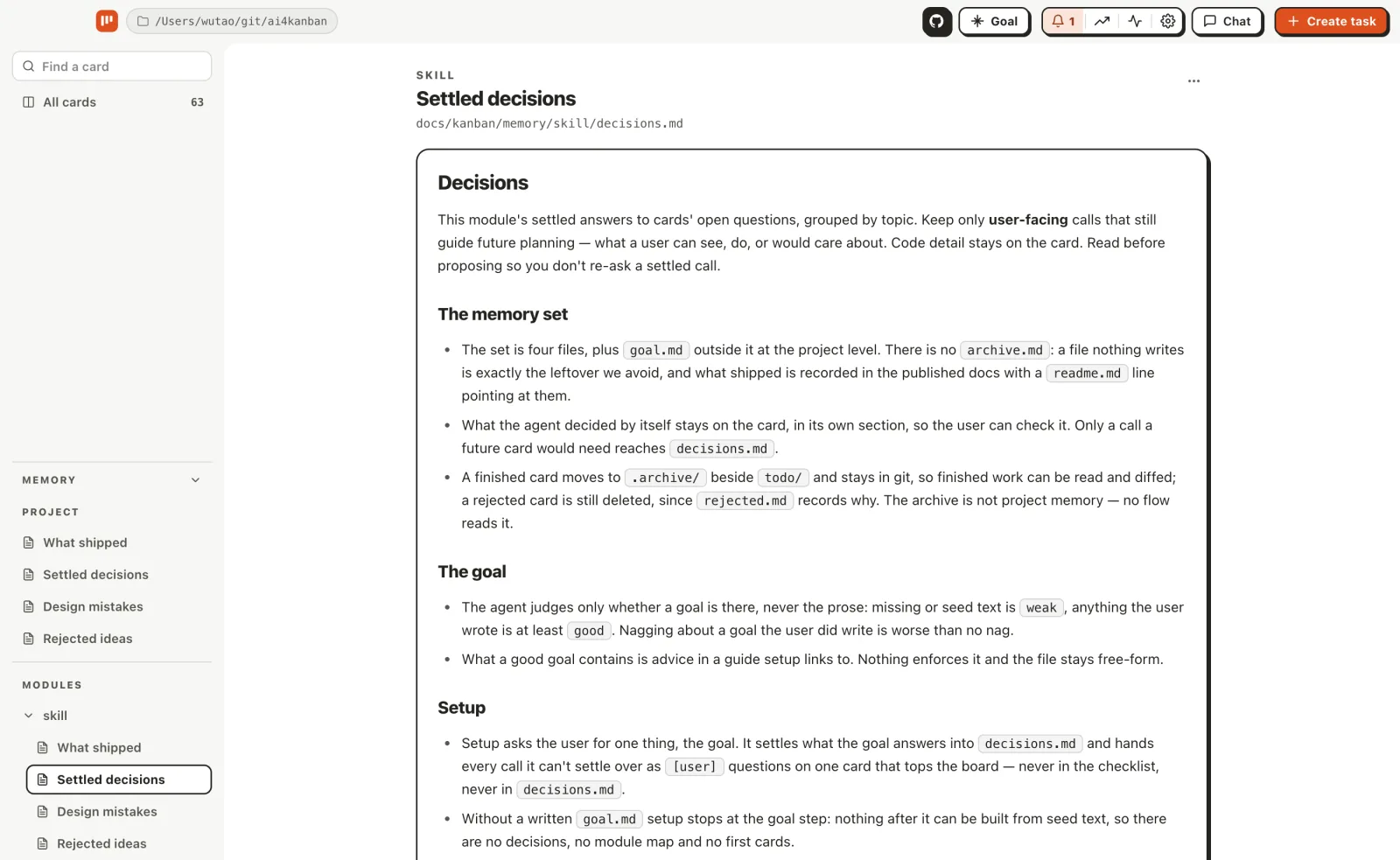
Claude Code's own CLAUDE.md and auto memory still apply. CLAUDE.md is useful for coding conventions and project instructions. Claude auto memory holds Claude's working notes. AI4Kanban memory is deliberately narrower: reviewed product decisions that later cards for the same part of the project should follow.
Read why project decisions become the bottleneck.
How do Claude Code subagents and agent teams fit?
They run inside an AI4Kanban task. The card remains the outer unit that defines the outcome, branch, worktree, review, and final status. Claude Code can divide the implementation among subagents or an agent team when its configuration and permissions allow them.
Claude Code's team task list coordinates workers inside that run. The AI4Kanban board coordinates the project across runs: a later card can depend on this card, reuse the decision it produced, or wait until its reviewed change has landed.
Claude Code stores agent-team configuration and task lists under the user's Claude directory. AI4Kanban does not copy that runtime state into the repository. It records the product requirement and delivery result that must outlive the team.
Does AI4Kanban replace my Claude Code configuration?
No. AI4Kanban launches the Claude Code CLI already installed on your machine. Your login, CLAUDE.md, rules, skills, hooks, MCP servers, permissions, and project commands remain in effect.
Claude Code loads those extensions at different points in a session. AI4Kanban invokes its /kanban skill directly and adds the current card plus the relevant project memory. It does not require an MCP server of its own.
Choose the login already used by your Claude CLI, an Anthropic API key, or an Anthropic-compatible endpoint once, for Claude Code itself. Then each agent on the board — planner, builder, reviewer, and each specialist — picks the model and reasoning effort it runs, so task preparation can think harder than implementation writes. Empty fields keep Claude Code's defaults.

Claude Code also keeps its existing permission rules. AI4Kanban does not silently bypass them. A denied tool call appears in the run log so you can change the task, the repository, or Claude Code's permission settings deliberately.
See What each coding agent can do for current connector support.
Can a failed card resume the same Claude Code session?
Yes. AI4Kanban assigns the Claude Code session ID before a run starts, so even a run that fails in its first seconds can be resumed from the same card. The card keeps its worktree and code changes; Resume continues the existing Claude conversation instead of rebuilding its context from the beginning.
AI4Kanban also makes Claude Code stop immediately when the provider returns a rate limit. Claude Code would normally retry for longer, but a background card should not occupy a run slot while no progress is possible. The failed card remains resumable, and other tasks can continue.
A separate silence timeout ends a run that stops producing output. You choose the timeout in Configuration, and 0 disables it.
Can AI4Kanban supervise several Claude Code tasks at once?
Yes. Claude Code agent view shows the sessions themselves. AI4Kanban decides which project tasks may start, based on card readiness and dependencies.
When automatic Git commits are enabled, each task gets its own branch and worktree. Independent tasks can run together; dependent tasks wait. Reviewed changes land on the target branch one at a time. If another task changed that branch, AI4Kanban rebases the next change and reviews it again. A Git conflict gets a focused Claude Code resolution run, followed by another review before landing.
Worktrees prevent concurrent sessions from overwriting the same checkout. The landing process handles the separate problem of 2 branches changing the same lines or producing behavior that no longer works when combined.
Which decisions and approvals pause AI4Kanban?
AI4Kanban pauses for 3 kinds of input:
- A product question: Claude Code could not settle a choice from repository evidence.
- Permission to implement: task preparation is complete, but the card does not start coding until you click Implement.
- Permission to land, when enabled: diff approval adds a checkpoint after automated review and before the reviewed change reaches the target branch.
Questions and review requests appear in the app and can be sent to Slack. Running and Landed are status only, so a finished turn is not presented as a request for input. AI4Kanban may commit and clean up a landed worktree after you authorize implementation, but it never pushes.
Frequently asked questions
Does AI4Kanban use my Claude subscription, or do I need an Anthropic API key?
Both work. Use the login already held by your Claude CLI, an Anthropic API key, or an Anthropic-compatible gateway. The selected provider is explicit, so a saved API key does not silently replace a subscription run.
Can I choose the Claude model for different kinds of work?
Yes. Give the planner, the builder, the reviewer, and each specialist their own Claude model and reasoning effort on the Agents pane. Tests run during implementation and review rather than in a separate testing stage. Empty settings keep Claude Code's defaults.
How much context does AI4Kanban add to a Claude Code run?
There is no fixed token number because task and memory size vary. Each run receives the current card, instructions for the current step, project memory, and memory for the modules that card changes. It does not load the whole board or replay AI4Kanban's chat history.
Can Claude Code update the AI4Kanban board itself?
Yes. The /kanban skill gives Claude Code commands for creating and preparing cards, splitting large tasks into subtasks, recording dependencies, answering questions, and updating task status.
Can Claude Code work in my main checkout instead of a worktree?
Yes. Disable automatic Git commits globally or for 1 task run. Claude Code then works in the current checkout and you handle the commit after review.
How are .env files, dependencies, databases, Docker resources, and ports handled in worktrees?
A worktree created by AI4Kanban begins with tracked files. Add an implementation rule that tells Claude Code how to install dependencies and prepare local configuration. Ignored files are not copied automatically. Ports, databases, and Docker names are still shared by worktrees, so parallel tasks need distinct values when the project requires them. Agent credentials stay in the ignored docs/kanban/.env file.
Who runs tests and decides that a task is done?
The implementation run follows the card's verification criteria. A fresh Claude Code session then checks the approved requirement and diff, fixes plain mistakes, and reruns focused tests. The approved requirement defines done; tests provide evidence that the implementation meets it. Enable diff approval when you want to inspect the final change yourself.
Will Claude Code commit, merge, push, or delete a worktree without my approval?
Clicking Implement authorizes automatic commits, 1 reviewed squash commit on the target branch, and cleanup of the delivery branch and worktree after landing. Enable diff approval for a second checkpoint, or disable automatic Git commits to manage Git yourself. AI4Kanban never pushes.
Can I use the same AI4Kanban board with another coding agent later?
Yes. AI4Kanban cards, dependencies, requirements, and project memory are agent-independent. Pick Codex, Cursor, OpenCode, or another supported coding agent for new work — for the whole board, or for one agent on it. A resumable Claude Code conversation remains tied to Claude Code.